
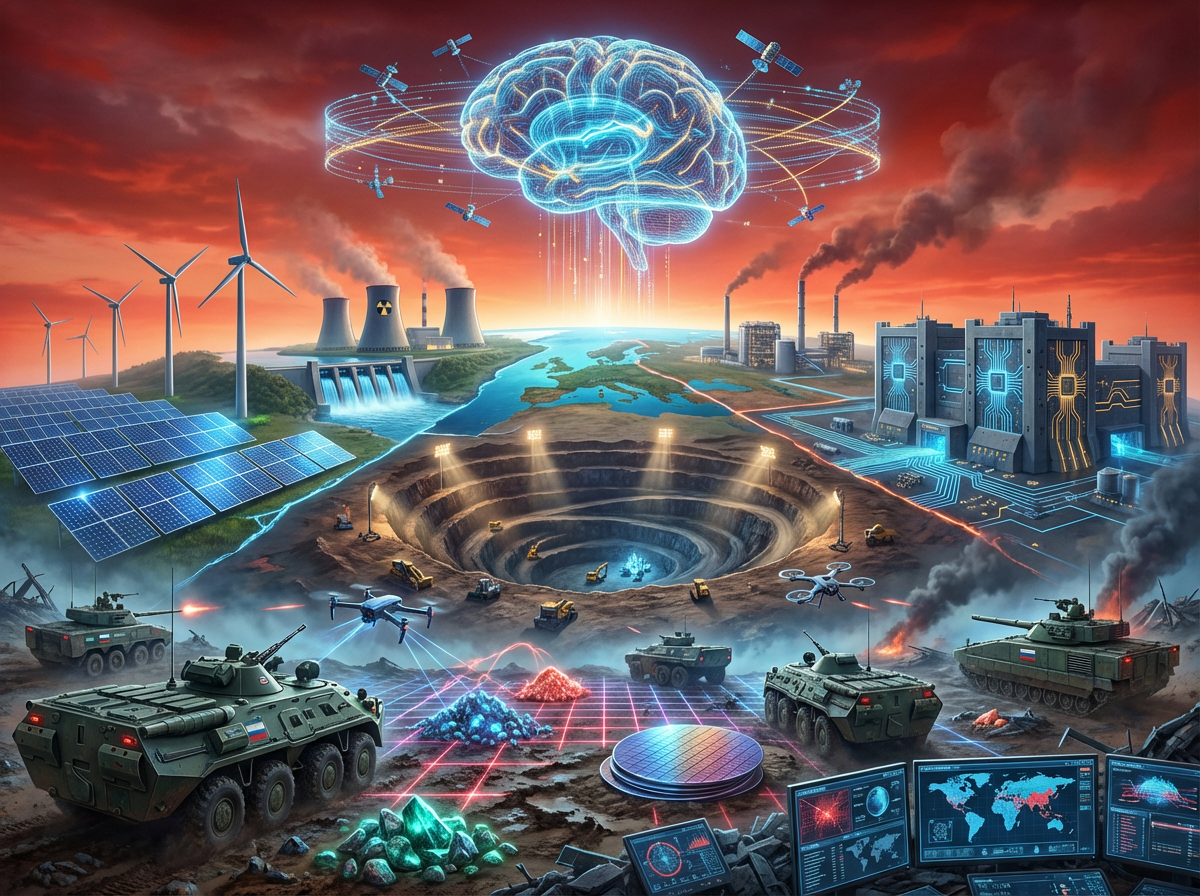
Historically, wars were fought over natural resources. Today, a new, 21st-century iteration has emerged: a competition for the resources essential to the advancement of artificial intelligence (AI). The future positioning of world powers hinges on their securing and controlling the critical minerals sources, semiconductors and energy required for AI.
In the past few years the US and China have locked horns in the technological and resource battle of the AI development race. For example, since 2022, in an effort to stifle China’s robust AI initiatives, the US has imposed a series of export controls on the high-performance GPUs China needs to get ahead in the AI race (though the US recently approved the sales of Nvidia’s H200 chips). In return, China has imposed a rare earths export ban to the US. These tit-for-tat actions will certainly persist as competition intensifies.
To help better understand the broader AI development landscape, let’s take a closer look at the three resource sectors most crucial to the global AI development race.
Critical Minerals
Critical minerals and rare earth elements are fundamental materials used in clean energy technology, advanced defense systems and AI infrastructures, including data centers and semiconductors.
Today, China dominates the global supply chain for critical minerals and rare earth elements (REEs). It possesses 70% of global rare earth mining and 90% of processing capacity. Further, it controls 98% of global gallium supply, 60% of global germanium refining, and 70% of cobalt refining capacity.
For the US, such sheer domination by China creates an uncomfortable and strategically untenable reliance on its primary economic and military rival. To counter China’s dominance, the US has been vigorously investing in its own supply chain resilience. Last month, on Feb 3, the US announced “Project Vault”, a USD12billion critical minerals stockpile. The same week, it also held the Critical Minerals Ministerial in Washington D.C., during which it launched the Forum on Resource Geostrategic Engagement (FORGE), joined by more than 50 countries.
Clearly, overreliance on China for critical minerals supply is a key concern shared by countries globally, as evidenced by China’s recent move to ban rare earth exports to Japan after the Japanese PM angered Beijing with her remarks on Taiwan.
To break China’s stranglehold on the critical AI resources, the US needs allies, both new and old. But with the Trump administration’s “America First” approach to diplomacy, it’s unclear how, and if, other nations stand to truly benefit from aligning with the new US regime. Already, we’ve seen the US leverage tariffs as a heavy handed bargaining tool – Indonesia offered greater access to its nickel industry to the US in exchange for lower tariffs, while Malaysia and Thailand signed a questionable MOU with the US that critics say would restrict their options to work with other key AI development players.
Energy
AI is power hungry, and the data centers that AI models run on are highly energy intensive. The energy consumption of data centers is expected to double what it is today by 2030, and is expected to rise further as the technology advances and usage increases.
The U.S. and China are taking very different paths to secure energy supplies. Over the past decades, China has gone from the biggest polluter in the world to becoming the leader of renewable energy generation. It has refined its supply chain for renewable energy, dominating the production of solar panels, wind turbines and batteries. Today, China produces 40% more energy than the U.S. Of the energy China produced, 38% comes from low-carbon sources.
The U.S., on the other hand, is driving in reverse gear. In a total disregard to climate change and world consensus, President Trump is doubling down on fossil fuel with an additional $4billion in industry subsidies per year over the next decade, making a 180 degree policy turn by pulling funding provided for clean energy under the Biden era Inflation Reduction Act (IRA).
Further, Trump has set his eyes abroad – Not only has he vowed to take Greenland, he took down the Venezuelan president in January, and has launched an attack on Iran over the last weekend that is set to escalate into a much wider regional conflict. These countries; Greenland, Venezuela and Iran – all have one thing in common – they are rich in oil and/or critical minerals. Such adventurism will surely contribute to further global instability.
Semiconductors
At the moment, the US’s edge over China in AI hinges on only one thing: chips. The best U.S. AI chips are estimated to be five times more powerful than the best Chinese AI chips (measured by Total Processing Power). A study has shown that 90% of the 130 Chinese language models released between 2017 and 2024 were trained on Western hardware. A bottleneck lies in the manufacturing capabilities due to export control of chipmaking equipment.
Without sophisticated AI hardware, China’s AI researchers are restricted in their ability to train AI models, even if it is on par or surpassed the US in other areas such as data, algorithm innovation and talent. But things might not stay that way forever. The US’ export controls have worked to slow China’s progress, but at the same time, it has also compelled China to focus on catching up with its own advanced innovations in chip design and manufacturing.
Conclusion
AI is one of the most significant technological breakthroughs for humankind, whether it’s the concern about massive job losses, autonomous weapons or existential risk for the human race. Its pursuit should not be a zero-sum game, as safe development of AI is a shared interest for all countries.
The competition between superpowers and tech giants to gain AI supremacy is bringing us closer to a full-on 21st century resources war. The current geopolitical dynamic of unfettered competition along with the weaponisation of resources is not conducive for the safe development of AI, nor will it provide a fair playing ground for the rest of the countries striving to develop their own AI capabilities and maintain AI sovereignty.
Regardless of which power ends up leading and winning the race for dominance of the global AI race, one thing is clear: energy, mining & technology companies are well-positioned to seize the massive profit opportunities. But given the increasingly fluid and fragmented geopolitical backdrop, companies will feel the pressure from governments to align strategically or at least make business decisions with more keen geopolitical consideration, in exchange for market access or funding. Navigating these complexities will require resource-rich countries, energy sector giants and emerging players alike to stay abreast of the quickly shifting dynamics, and be prepared to adapt to the changing policy and regulatory environments.
Contact Aurora:
How can your company correctly build your efforts in order to navigate the geopolitical dynamics and come on top?
To explore how our services may help, contact us @info@aurorainsights.co or book a call to talk to us.
To learn more about how your company might be exposed to geopolitical risk, take our free Geopolitical Exposure Assessment.
Leave a Reply