
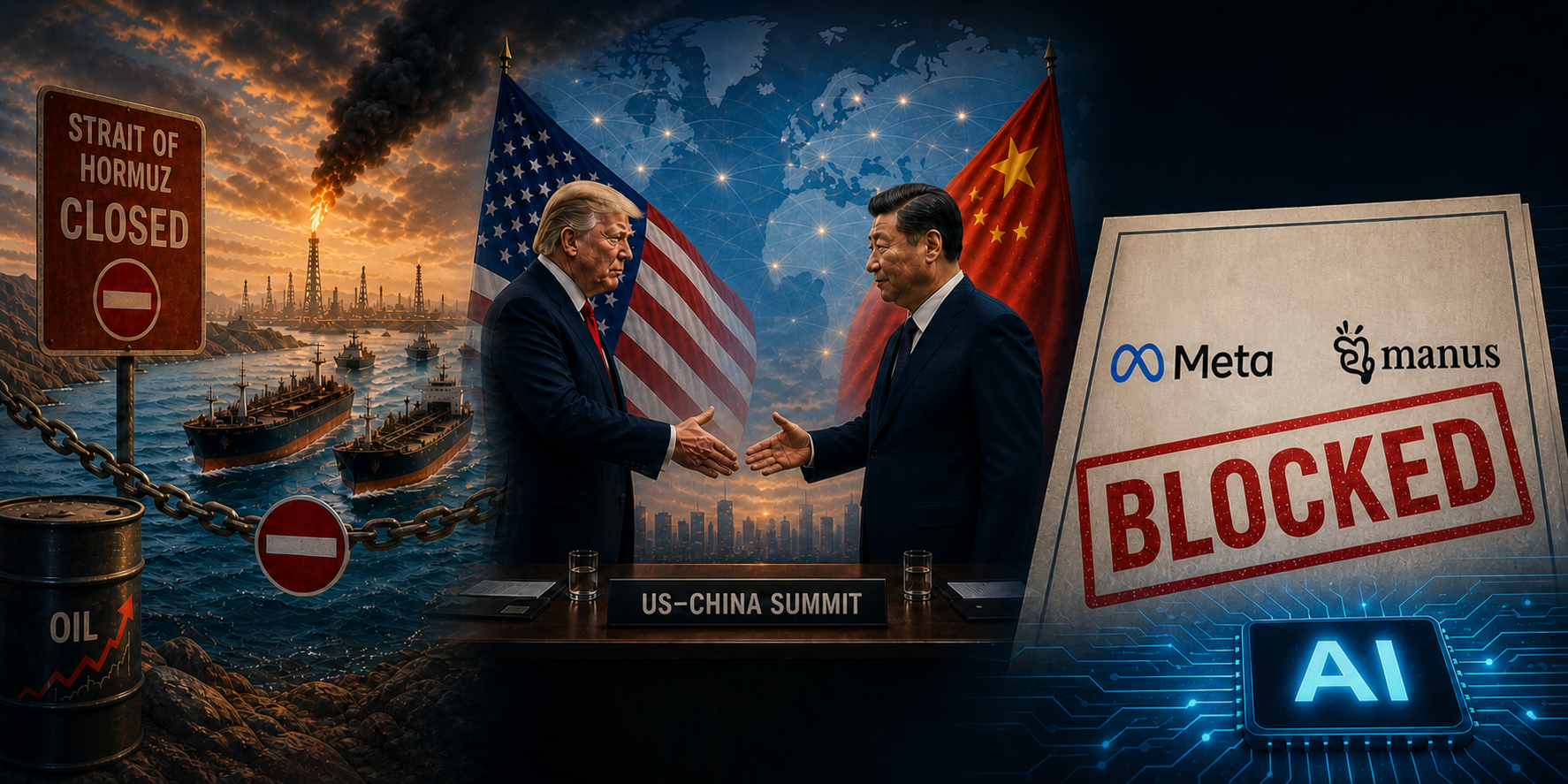
April 2026 was not a month of isolated crises. Three separate fault lines – energy security, AI governance, and steepening US-China competition – are converging simultaneously. Together, they mark a structural shift that no company in Southeast Asia can afford to treat as background noise.
When Hormuz Becomes Malacca
We are now entering the third month of the Iran war and the de facto closure of the Strait of Hormuz. A conditional ceasefire between the US and Iran has been extended, but virtually no shipping traffic is utilizing the strait – vessel traffic remains at roughly 5% of pre-conflict levels.
This is no longer a temporary, acute shock. It is a sustained disruption compounding into structural economic damage – not just for the Middle East, but for the global economy at large.
Southeast Asia has borne a disproportionate share of the burden. Without meaningful strategic reserves, fuel shortages have already disrupted operations and transportation across Thailand, Vietnam, Indonesia, and the Philippines. In the months ahead, elevated oil prices will feed through into consumer goods prices and cost of living across the region.
Against this backdrop, OPEC’s cohesion is fracturing precisely when coordinated supply management matters the most. On 28 April the UAE announced that it will leave OPEC and the broader OPEC+ alliance, effective 1 May. The departure ends more than five decades of membership and reflects longstanding friction over production quotas: the UAE has consistently pushed to raise output beyond OPEC’s ceilings. With the strait effectively closed to exports regardless, the move carries no immediate broad market impact. In the long run however, the decision is much more consequential.
Additionally, the closure has also prompted a more uncomfortable discussion closer to home. Indonesia’s Finance Minister Purbaya Yudhi Sadewa, citing President Prabowo’s directive to position Indonesia as a more active participant in global commerce, raised the idea of charging ships transit fees through the Strait of Malacca, through which approximately a quarter of global maritime trade passes. The proposal was quickly dismissed. Indonesia’s own foreign minister walked it back days later, acknowledging the country’s obligations under UNCLOS. Singapore’s Foreign Minister Vivian Balakrishnan was categorical: transit passage is a legal right, not a privilege; and Singapore would not participate in any toll arrangement.
The trial balloon nevertheless revealed something real. Jakarta is watching Iran monetise a chokepoint and asking what leverage Indonesia holds. That question will not disappear because one minister was embarrassed.
Separately, satellite imagery from 10 & 11 April showed that China has deployed a floating barrier and multiple vessels at the entrance to Scarborough Shoal, a traditional fishing ground that lies within Philippines’ Economic Exclusive Zone (EEZ) which China also claims. Analysts note that China may be taking advantage of US attention being fixed on the Hormuz crisis to quietly advance its position in the South China Sea.
Meanwhile, the region’s ASEAN partners have failed to respond to the Iran conflict with a unified front. Instead, Malaysia and Thailand separately secured direct access to the strait through bilateral talks with Iran – a fragile but meaningful carve-out. Singapore, by contrast, declined to negotiate, stating that freedom of transit under international law is not subject to bilateral bargaining. The divergence is a live illustration of ASEAN’s structural limits when individual member interests diverge.
Aurora’s Read:
Three assumptions that most Southeast Asian businesses built their regional risk frameworks around have now been tested in live conditions. First: that strategic energy reserves would absorb disruption. They did not. Second: that international maritime law constrains unilateral action. Events prove it constrains rhetoric; not behaviour. Third: that ASEAN would present a common front. It has not, and it will not.
If you are a CEO or CFO in energy, logistics, manufacturing, or any supply-chain-dependent business in Southeast Asia, the question is not whether exposure exists. Of course it does. The question is whether your current risk framework actually reflects the world as it now operates, or the world as you assumed it would.
The Trump-Xi Summit and What does it mean for ASEAN
The Trump-Xi summit in Beijing, scheduled for 14-15 May, will be the most consequential US-China meeting in nearly a decade. It is Trump’s first trip to China in eight years, arriving amidst one of the most turbulent periods in the modern bilateral relationship.
The pre-positioning matters as much as the actual outcomes. US Trade Representative Jamieson Greer has signalled that Trump will seek “stability” rather than a reset, with rare earth supply and the outlines of a bilateral Board of Trade among the items slated for discussion. Treasury Secretary Bessent has indicated that a framework agreement is within reach that covers a tariff truce, resumed Chinese purchases of US soybeans, and a year-long pause on rare earth export restrictions.
ASEAN’s exposure to this process is structural, not incidental. US Section 301 investigations into Southeast Asian manufacturing remain active, specifically targeting the transshipment routes through which Chinese goods enter US markets via regional producers. Vietnam, Thailand, Malaysia, and Indonesia are all in frame.
Unfortunately, the region’s leverage in that conversation is limited, but its exposure to the consequences is not. If Washington and Beijing reach a bilateral stabilisation deal – whether on rare earths, chip supply chains, or trade – it will be negotiated without ASEAN at the table.
Aurora’s Read:
Watch the annexes, not the headlines. A framework on soybeans and rare earths leaves technology access restrictions, chip controls, and transshipment enforcement entirely unresolved. For manufacturers and logistics operators in Southeast Asia, those are the live pressure points — and they will not be addressed in Beijing on 14 May. The summit’s real significance lies in what it leaves open, and how that shapes the next wave of US trade action.
If your business sits anywhere in the China-exposed supply chains running through this region, a bilateral diplomatic handshake is not structural relief. It is a temporary reduction in headline noise. Plan accordingly.
The Manus Veto: China’s Regulatory Reach Now Extends to Southeast Asia
On 27 April, China’s National Development and Reform Commission (NDRC) blocked Meta’s $2 billion acquisition of Manus, an agentic AI startup founded by Chinese engineers that had legally relocated to Singapore. The NDRC issued a one-line statement, offered no explanation, and ordered the deal unwound entirely, four months after it had closed.
The assertion of jurisdiction is what makes this significant. Manus had incorporated in Singapore, relocated its headquarters and over 100 employees to the city-state, and was operating within Meta’s Singapore offices at the time of the ruling. None of that insulated the deal from review. Co-founders Xiao Hong and Yichao Ji were reportedly barred from leaving mainland China in March while the NDRC conducted its assessment.
This is a direct signal that Beijing treats the Chinese origin of founders and intellectual property as sufficient grounds to assert jurisdiction, regardless of where the legal entity sits. It effectively ends the “Singapore-washing” model: the practice of relocating a Chinese-founded company to Singapore to achieve jurisdictional separation from Beijing and access to Western capital.
Aurora’s Read:
If you are an investor, acquirer, or board member with exposure to AI assets in Southeast Asia, the Manus ruling is not background reading. It is a live diligence risk that belongs in your deal process now. The question to ask of every deal structure involving Chinese-origin founders or IP is simple: does Beijing consider this asset within its reach? The answer may no longer depend on where the company is incorporated. It may depend on who built it, and where they were born. Any assumption that Singapore incorporation provides clean jurisdictional separation from Beijing needs to be revisited — deal by deal, asset by asset.
Aurora’s Summation
April demonstrated something that most corporate risk frameworks are not yet built to handle: the convergence of energy disruption, AI governance, and US-China competition into a single, interconnected risk environment. These three domains are no longer moving in parallel. They are moving together, and they are accelerating each other.
May will not be quieter. A US–China summit, a still-closed strait, a fracturing OPEC, and a tech regulatory environment that just moved Beijing’s reach into Southeast Asia’s corporate structures — this is the fraught environment in which decisions are being made. The executives who come out of this period ahead will be those who stopped treating geopolitical risk as a monitoring exercise and started treating it as a strategic input. The window to act before the next disruption compounds is now.
This article was first featured in our Newletter. Click here to subscribe.
Leave a Reply