
By Conor Salcetti & Ivy Kwek
The highly anticipated Trump-Xi summit in Washington has concluded, marking the second meeting this year between the two leaders following the Beijing summit in May. This most recent dialogue underscores a remarkable evolution in the bilateral relationship that, only a few years prior, was defined by deep systemic friction. This time Trump pulled out all the stops, greeting Xi on the tarmac on his arrival, a rare gesture for a visiting head of state. The warmth contrasts with his tone toward some allies, and is ironic from a man who once called China a menace.
The headline takeaway suggests that both sides are prioritising bilateral stability, a posture likely to hold at least through year-end. But that should not be mistaken for evidence of a fundamental thaw in US–China relations.
For President Trump, the summit is a prelude rather than an endpoint. The real test is the November midterm election. That helps explain the emphasis on short-term stability, including the two-month truce extension to January 10, which was shorter than many had expected. The shorter duration could reflect a desire to secure temporary calm ahead of the election, although it may also indicate that important negotiating issues remain unresolved.
The two-month extension was reportedly one of the summit’s more concrete deliverables, alongside a new Artificial Intelligence (AI) communication channel and reciprocal tariff reductions covering approximately $30 billion in trade on each side. The product lists, which include Chinese toys and household appliances and US agricultural goods and cosmetics, are the Board of Trade’s first concrete output since its creation in May. Soybeans, the largest US agricultural export to China, were however excluded, which may signal Beijing preserving leverage.
China, meanwhile, has an interest in presenting the visit as a meeting of equals. Critics may argue that Washington granted Beijing a propaganda victory, but China’s leverage is more real than the pomp on display. Beijing has demonstrated that its rare earth export controls can create strategic pressure, and it has little incentive to hand Trump a major concession before the midterms.
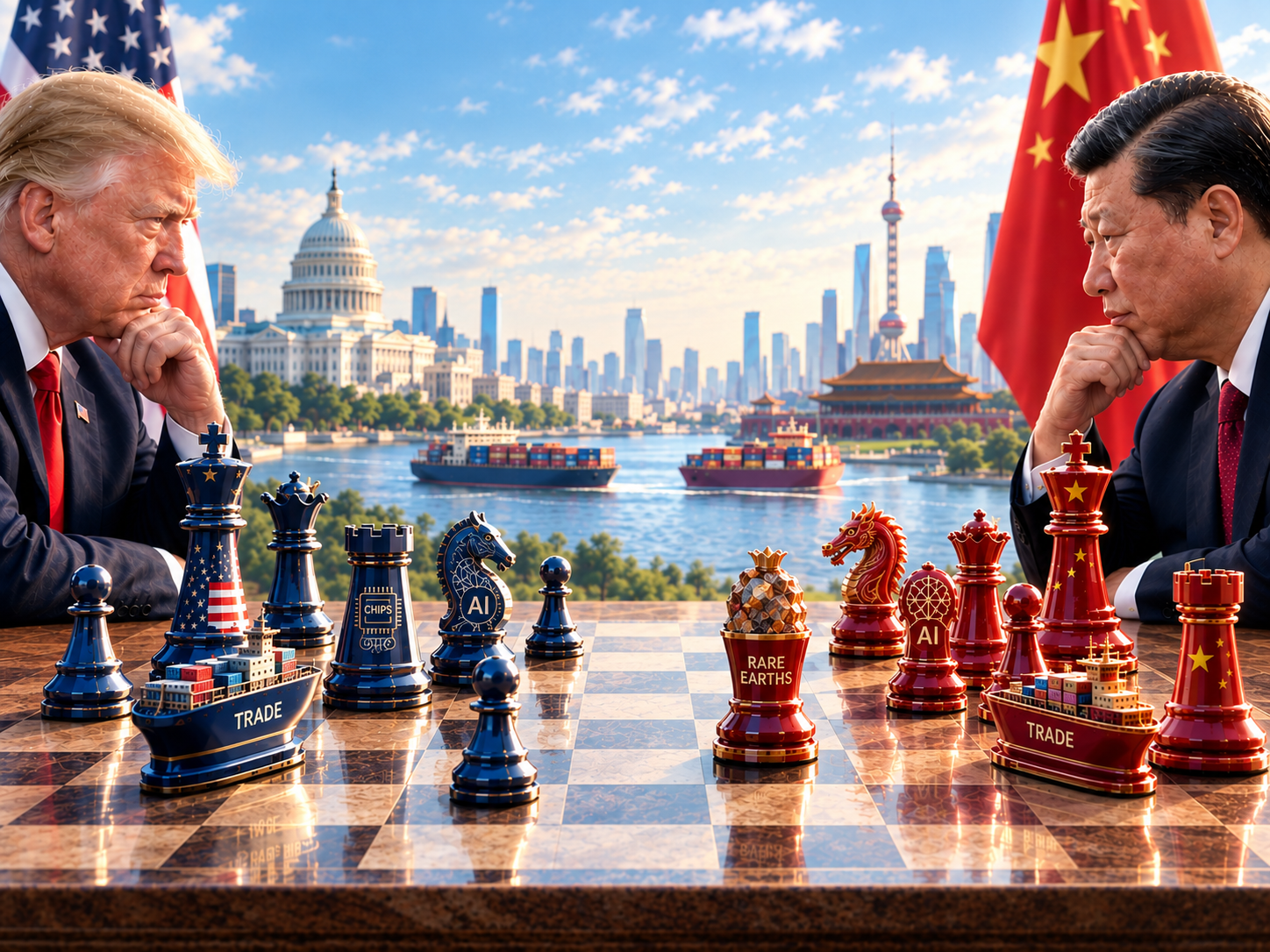
Unsurprisingly, the summit produced little progress on the big issues: no breakthrough on rare earth controls or US semiconductor export controls, and limited movement on AI governance beyond the new dialogue. The Board of Investment, though formally launched, has yet to show tangible results, likely reflecting sensitivities around Chinese investment in strategic US sectors. Neither side seems willing to make meaningful concessions on matters that directly implicate national security and technological competition.
The summit took place with Washington on the defensive on the home front, where Trump currently has a historically low approval rating of 32%. Additionally, just days before the summit, in a move which has been interpreted as a sign of political defensiveness, the White House barred CNN, MS NOW and Politico from access. The pomp afforded Xi also drew bipartisan criticism from Capitol Hill for giving Beijing a propaganda win without concessions on the issues dividing the two countries. With the unresolved Iran war and the resulting oil shock, bond yields at two-decade highs and a rising cost of living, problems that owe more to Washington’s own making than to China’s, the administration more than has its hands full.
Both leaders are keen to keep the show going. Like newfound best friends promising to attend each other’s parties, Trump will go to APEC in Shenzhen in November and Xi to the G20 in Miami in December. That signals continuity of dialogue, or at least the appearance of it.
Several developments in the coming months will test the durability of that relationship:
- The Section 301 investigation. The outcome of the US investigation into structural excess capacity, which covers 16 economies including China and several in Southeast Asia, is expected this fall and could produce new tariffs or trade measures.
- The next trade-truce deadline. The January 10 deadline could become the next major test of whether the temporary calm created by the summit can be extended.
- Taiwan arms package. The $14 billion package, paused since May, has been described by Trump himself as a negotiating chip. Any decision to proceed could provoke a Chinese response, likely rare earth retaliation or a Xi no-show in Miami.
- The Graham-Blumenthal Act. The recently enacted law authorises tariffs of up to 100% on the major importers of Russian oil and gas, a group likely to include China as the largest buyer of Russian crude. The first determinations are due by October 18, with Trump retaining discretion over rates.
These developments matter because the summit did not resolve the underlying sources of rivalry. Trump’s fixation on a warm personal bond with Xi, and both sides’ short-term need for stability, should not obscure the harsher reality: the relationship remains structurally defined by competition and distrust.
In Washington, the logic of securitisation – treating China as an existential or zero-sum rival – continues to shape policy, especially in AI, semiconductors and other strategic technologies. In Beijing, concerns about containment and economic coercion reinforce the incentive to reduce dependence on US-controlled technologies and supply chains. These dynamics make durable compromise difficult.
For businesses and investors with Asia-Pacific exposure, the practical message is therefore mixed. The summit may reduce immediate uncertainty, but it does not amount to a strategic reset. Companies should plan for episodic relief rather than a permanent easing of tensions. Tariffs may be paused, but export controls, investment restrictions, supply-chain disruptions, sanctions exposure and technology regulations are likely to remain subject to rapid policy reversal motivated by political tit-for-tat.
The current calm may last through the remainder of the year, particularly if both governments value stability around the November midterms and the upcoming multilateral meetings. It should not, however, be assumed to endure for the rest of Trump’s term. The unresolved great-power rivalry points to a relationship that is managed, rather than repaired.
Leave a Reply