
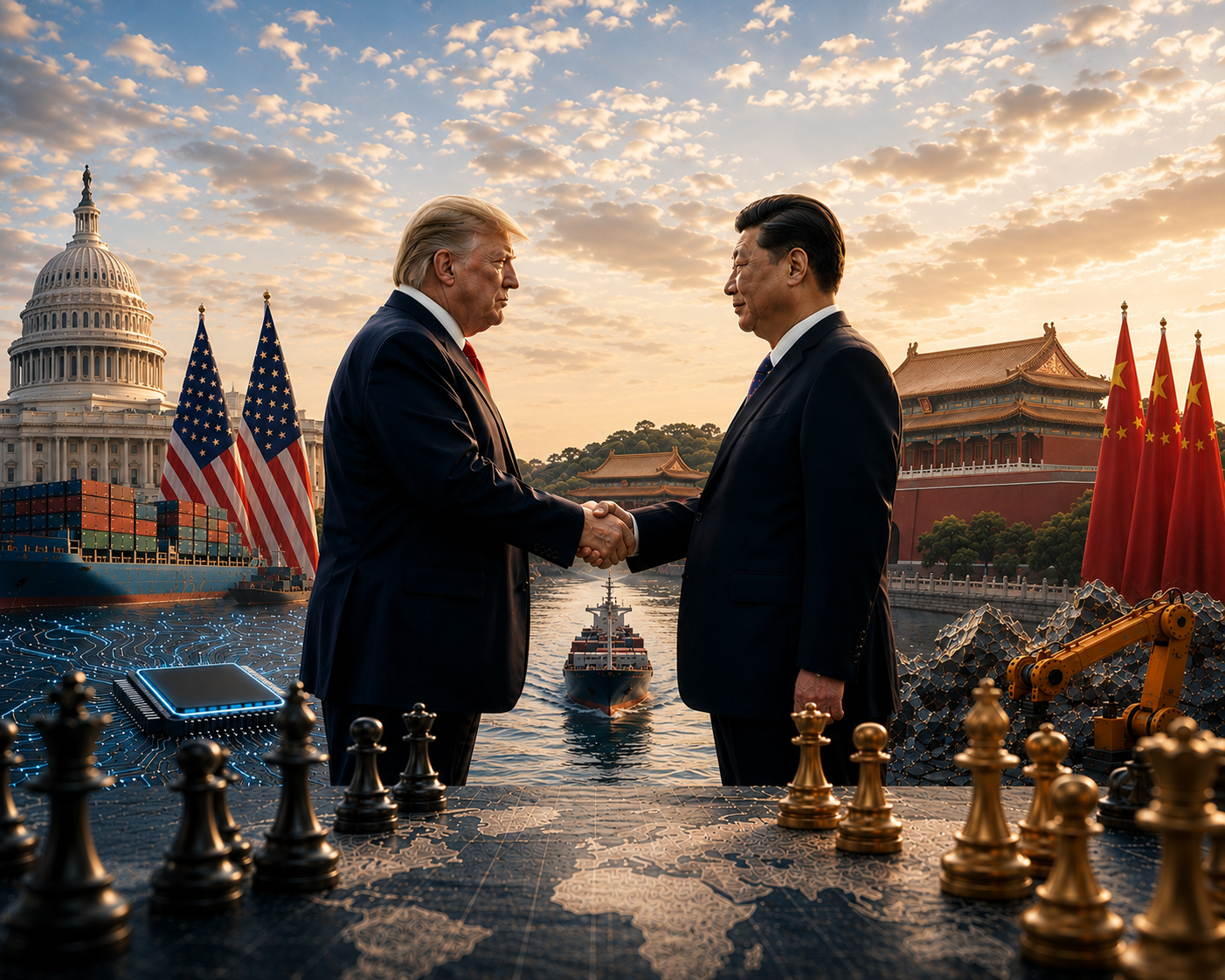
The most consequential bilateral meeting of the year has concluded. Just as we noted in our May newsletter, there were no major announcements, no substantive agreements, no structural breakthroughs.
As the dust settles from President Trump’s 48-hour whirlwind Beijing tour that was wrapped in diplomatic pomp and pageantry, three of our Aurora Insights analysts break down what the Summit did and didn’t achieve, and what it means for businesses navigating the fault lines ahead.
Overview: A Summit that is Hollow by Design, with Mismatch in Priorities
By Ivy Kwek, Chief Executive Officer
For all the attention that it gets, the wrap of the Summit felt anti-climatic. But those who expected more from the Summit were not reading the room: the current architecture of the US-China relationship does not reward grand gestures, and neither leader had the incentive to change the fundamentals.
Viewed through the right lens, the Beijing summit accomplished precisely what both sides wanted, and needed it to: to portray stability for the fraught US-China relationship. China’s readout lauds the building of a “constructive China-U.S. relationship of strategic stability,” to be led by cooperation and “measured competition” with manageable differences that will serve as a guiding framework for the next three years. For an international business community that has spent the past years navigating whiplash-level volatility between Washington and Beijing, that is a relief. The question is: how would it be managed, and for how long?
Beyond that, there was a mismatch between the US and Chinese priorities going into the meeting. For China, it’s Taiwan. Xi used the meeting to reinforce Beijing’s position, directly warning Trump that mishandling Taiwan would cause “clashes and even conflicts, putting the entire relationship in great jeopardy”. Beijing did not secure a shift in the US official language from “do not support” to “oppose” Taiwan independence, but it walked away with something arguably more useful: Trump’s non-committal on the pending $14 billion arms package and an explicit statement of disinterest in a conflict “9500 miles from home”.
For the US, it’s Iran. Trump needed to project strength, and China offered him the scaffolding for it – a pledge to support reopening the Strait of Hormuz and a commitment to withhold military equipment from Tehran. The details, however, remain thin. Whether this constitutes genuine strategic coordination or careful face-saving for both sides will become clear only when tested.
What the summit did not produce matters as much as what it did. The one-year trade truce agreed in Busan last October remains unextended beyond November. The structural tensions on AI governance, semiconductor access, rare earths and nuclear arms control remained untouched. These are the fault lines that will determine the success of the fragile US-China relationship.
The détente is real, but it is tactical. The space it opens for regional businesses is genuine, but temporary. Executives operating across the U.S.-China corridor should treat this as a window, not a settlement. The underlying competition has not softened. It has merely agreed, for now, to play nice.
View from the US: Managed Optics, Unresolved Rivalry
By Conor Salcetti, Analyst
From Washington’s vantage point, the 14-15 May Beijing summit delivered what the Trump administration needed and little more: a credible image of “managed stability” without structural concessions. The choreography did most of the work. Xi received Trump at the forecourt of the Great Hall of the People, conveying peer-to-peer great-power optics. A high-profile American business delegation signalled Washington’s preference for a business-first relationship with China, driven by Trump-style dealmaking. Announced deliverables — a 200-jet Boeing commitment and a White House claim of $17 billion annually in US agricultural purchases through 2028 — generated favourable headlines, though Beijing’s official readout confirmed neither figure. However, across the core agenda — tariffs, Ukraine, Taiwan, AI, and export controls — progress was negligible.
Through the remainder of 2026, the White House faces three converging pressures against escalation: domestic political headwinds ahead of the 3 Nov midterms; Beijing’s demonstrated willingness to weaponize critical minerals supply chains; and geopolitical overextension from the ongoing Iran war. With that context, the meeting itself was the deliverable — a performance of equilibrium from which Beijing extracted more durable strategic value, particularly by prominently spotlighting the Taiwan issue. Xi’s proposal of a “constructive China-US relationship of strategic stability” as the guiding framework for the next three years is a deliberate play to lock in détente terms that buys Beijing time to build up more resilience while constraining US room for maneuver. Whether Washington holds to Xi’s vision is the more open question. Despite positive summit signalling, the bilateral relationship remains structurally locked into geostrategic rivalry. No interpersonal rapport meaningfully resolves that competitive dynamic.
Looking ahead, the US-China Board of Trade and Board of Investment — announced in the White House Fact Sheet but absent from Beijing’s official readout — is the summit’s most structurally novel and ambiguous outcome. If operationalized with genuine enforcement teeth, the boards could create a standing channel for dispute management, although the unsuccessful Phase One trade deal compliance precedent warrants scepticism. For now, the November 2025 Busan truce continues to hold on paper, with USTR Section 301 exclusions on 178 Chinese products and Beijing’s rare-earth licensing pause both running to November 2026.
Separately, the Section 301 investigation on overcapacity covering China and key ASEAN transshipment economies, including Vietnam, Malaysia, Thailand, and Indonesia, which Aurora Insights wrote about in an Advisory Note, is due around 24 July — a pressure point that precedes and potentially complicates Xi’s scheduled visit to Washington on 24 September. The September visit also serves as a de facto deadline to negotiate a truce extension or successor framework before November’s expiration. For businesses with Asia Pacific risk exposure, the July Section 301 determination and the November truce window are not distant risks — they are active planning horizons that should be anchoring scenario work now.
View from China: Warmth with Chinese Characteristics, but Boundaries Remain
By Yen Sin Khu, Analyst
China has pulled out all the stops for Trump’s visit, from the grand reception at the Great Hall of the People with 21-gun salute, to the highly curated, lavish State Banquet. Yet, it was the following two venues from this visit, the Temple of Heaven and Zhongnanhai, that best captured how China wants to define its relationship with the US. The former embodies the classical Chinese concept of harmony among all things, reflecting how Beijing wants to frame the relationship with Washington: peaceful, cooperative, and stable. The latter made it personal, where Xi was heard telling Trump that he rarely hosts foreign leaders in the secret garden as they pause to admire ancient trees and blooming roses. The choice was no coincidence – China intends to signal friendship, goodwill and trust.
But behind the warmth, the harder questions remained unanswered. Beijing’s signals on both rare earths and chips were deliberately vague, with no policy confirmed and no statement released. Arguably, China has the upper hand in the AI race, so it has little reason to make concessions. Export controls on advanced chips might cause temporary hindrance to the Chinese tech industry, but China is not in a rush to buy American chips because it is developing its own, and fast. DeepSeek’s latest release of the V4 model has moved fully onto Huawei’s Ascend 950 chips, and major Chinese tech firms are racing to place orders. In fact, Beijing has stalled the shipment of Nvidia H200 chips even after the US approved the sales and is encouraging Chinese tech firms to buy from domestic manufacturers such as Huawei.
At the same time, it holds the powerful rare earth card and will not easily give up either – China controls 90% of global rare earth refining and supplies 70% of U.S. rare earth imports, many of which are essential to the aerospace and defense industry. But imposing export control is not simply a retaliation against US restrictions on China’s access to advanced chips. It serves a far longer purpose: to prioritise Beijing’s own green energy transition, upgrade its domestic industry, and secure its place at the top of the global supply chain.
What China truly needs is a stable and predictable external environment, one that cannot be arbitrarily disrupted by unilateral US policy. Trump’s goodwill gesture of approving chip sales to ten Chinese firms and arriving with a delegation of leading tech CEOs signals that Washington still wants to negotiate with China. Afterall, the cost of decoupling over rare earths and chips has become impossible to ignore for both sides. The battle for technological dominance does not pause for the summit, but both sides understand that a stable global supply chain of chips and critical minerals serves everyone’s interest.
Leave a Reply