
By Yen-Sin Khu, Analyst
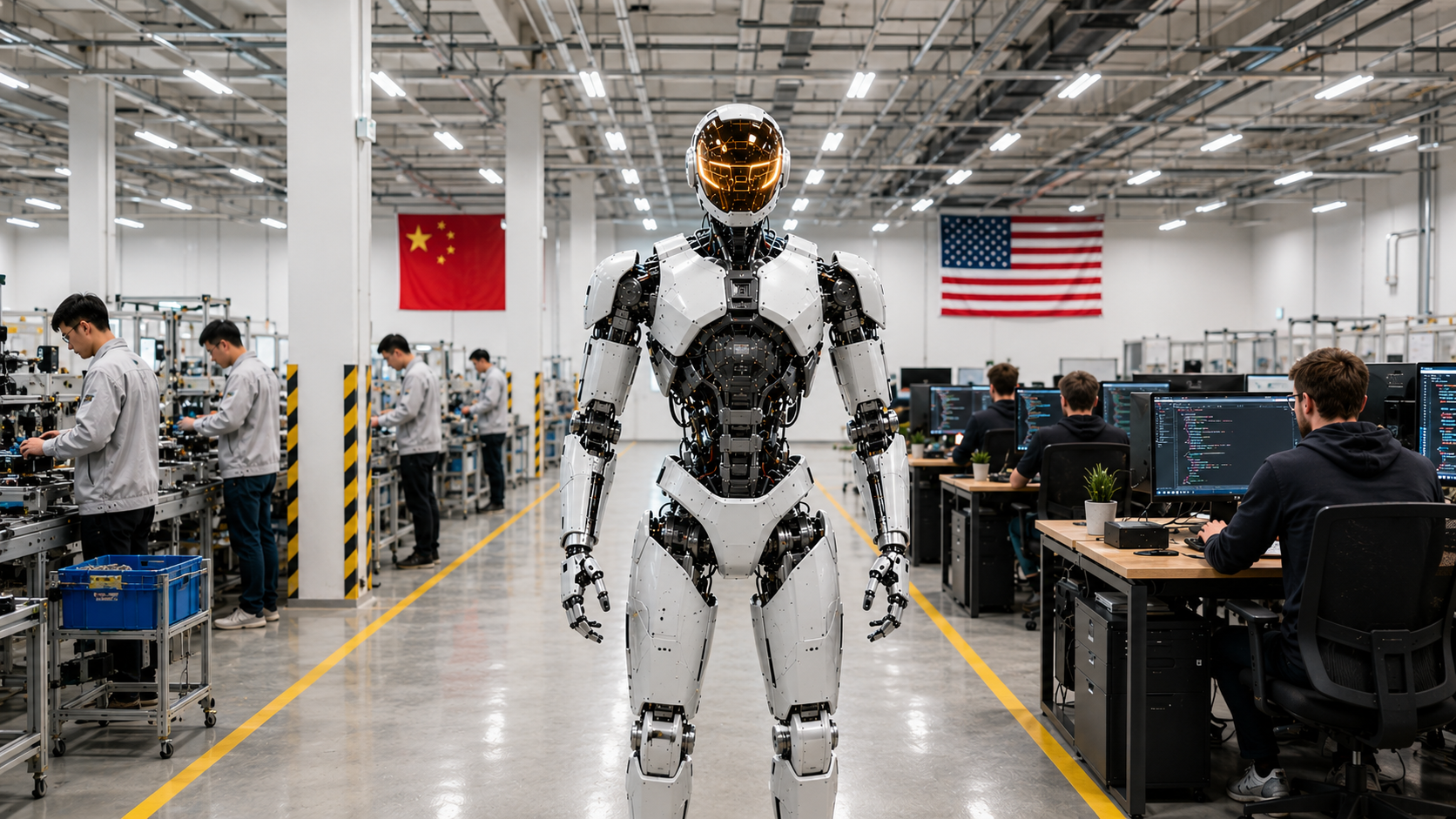
Physical Artificial Intelligence (AI) is the next frontier of US-China technological competition. China is currently in the lead for the hardware race, but the building of the robot’s “bodies“ isn’t the only battleground. The real battleground includes the “brain;” the controlling software for the robots.
Last month, Unitree, a Chinese startup and leading humanoid robot maker, became the unlikely center of the AI and geopolitical conversation. Nvidia, currently the largest semiconductor company in the world by market capitalization and annual revenue, announced that it was working with Unitree to build a research-focused humanoid robotics system to be used by Stanford, ETH Zurich, and UC San Diego. Around the same time, Chinese humanoid robots appeared on America’s Got Talent, drawing fresh international attention to just how far China’s robotics industry has come. The optics were striking, and the implications run deep.
Humanoid robots are no longer a futuristic concept confined to research labs. They are rapidly becoming the next frontier of geoeconomic competition, attracting billions of dollars in investment and prompting governments to treat robotics as a strategic technology alongside semiconductors and AI. Morgan Stanley Research forecasts that there could be more than 1 billion humanoids in use by 2050, with the market likely reaching $5 trillion by 2050. This makes humanoid robotics worth watching not only as a future global labor and automation market, but also as a test of whether it will be U.S. software strength or China’s manufacturing ecosystem that will dominate the next generation of physical AI.
China’s hardware advantage is real – and expanding
China’s advantage lies in the robot’s physical layer: the frame, actuators, joints, sensors, batteries, hands, and legs. Its existing strengths in electric vehicles, batteries, motors, and precision manufacturing give Chinese robotics companies access to a deep supply chain and factory infrastructure. that no other country can match at scale. In 2025, Unitree alone shipped more than 5,500 humanoid robots. Its Shanghai-based rival, AGIBOT, shipped 5,100 humanoid robots last year. In contrast, Tesla, Figure AI, and Agility Robotics each only shipped approximately 150 units last year. By 2050, China is projected to have 302 million humanoid robots in use, more than triple the US figure of 77 million. Nearly every robot developer in the world relies on critical components sourced from China and other parts of Asia, like screws, reducers, motors, and batteries.
But Beijing is not content to remain solely the World’s robot factory. Beijing is shifting its robotics strategy from simple hardware assembly to the frontier of “Embodied AI,” i.e., the fusing of physical machinery with self-learning software. Under the 15th Five-Year Plan, embodied AI has been elevated as a strategic priority. A national venture capital guidance fund is expected to attract nearly 1 trillion yuan for frontier technology sectors. The policy signal is clear: Beijing is trying to close the software gap as deliberately as it built its hardware lead. China is not experimenting. It is industrialising and accelerating at scale, while most of the rest of the world just watches.
US dominance in software architecture: The brain is the battleground
While China’s manufacturing lead covers the hardware layer – the “body,” the contest for the software, or the “brain,” is where the US currently holds an advantage. US-headquartered companies captured 52% of global robotics venture capital in 2025 – $4.9 billion of $9.4 billion total. Vision-language-action (VLA) architectures, the AI frameworks that allow robots to interpret language, perceive environments, and execute physical tasks, remain US-dominated.
Nvidia’s Isaac GR00T provides a software stack from data generation and simulation to on-robot deployment, and its latest model reportedly outperforms leading competitors by more than double on generalist robot policy benchmarks. Nvidia is therefore not just building better robots. It is positioning itself to set the terms on which the entire physical AI industry operates.
At the same time, the US hardware picture is not standing still. Figure AI has scaled production from one Figure 03 robot per day to one per hour, while Agility Robotics announced it will go public through a US$2.5billion Special Purpose Acquisition Company (SPAC) deal to raise over US$6200 million for commercialization. What appears today to be a division between Chinese hardware and American intelligence may be only a temporary stage of development, and the distance between them is narrowing.
Governments are already drawing lines
A humanoid robot is not just a machine. It is a moving data system connected to cameras, sensors, cloud services, and software updates. Whoever controls that system can influence how data is collected, where it is processed, how the robot behaves, and which standards others must follow. This is why the U.S.-China robotics race is no longer a commercial question.
Governments are already drawing lines. In the United States, the American Security Robotics Act of 2026 restricts the federal government from procuring Chinese-made ground robots. The newer Guarding the U.S. Against Adversarial Robotics Dominance (GUARD) Act goes further by requiring national security agencies to review humanoid and quadruped robots made by China or other countries, and holds power to prohibit any robots deemed to pose a national security risk from entering the US market. These bills are still in the early legislative stages, but they show where the politics is heading. Humanoid robots are already being viewed through the same strategic lens as semiconductors, AI models, and rare earth.
China retaliated in kind: In June 2026, China’s Ministry of Finance barred government agencies from purchasing products made by 46 US companies, primarily defence contractors, following the US expansion of its Section 1260H “Chinese military companies” list to include Unitree. Robotics has become part of a wider cycle of geopolitically driven technology restrictions.
What Southeast Asia must decide
For Southeast Asia, this is not a distant issue – it is already inside the physical AI supply chain. The Nvidia-Unitree partnership puts a Southeast Asian company in the spotlight: Sharpa, a Singapore-headquartered firm whose 22-degrees-of-freedom robotic hands will serve as the hand supplier for Nvidia’s reference humanoid. Also, Shanghai based AGIBOT has already secured a regional foothold in Singapore through a Singtel Enterprise agreement, with deployment spanning logistics, retail and hospitality. Southeast Asia is simultaneously a component supplier, a deployment market, and a testing ground for the governance frameworks of physical AI.
What matters now is which ecosystem businesses and governments choose to embed themselves in. Choosing a US-backed robotics system means plugging into American data ecosystems, software architecture, and security requirements. Choosing a Chinese-backed system means accessing Chinese hardware supply chains, pricing advantages, and manufacturing depth, along with Chinese regulatory exposure. This is not a technical choice. It is a strategic decision. And as both sides continue to develop their respective platforms, the decision becomes progressively harder to reverse.
Conclusion
The phrase “Chinese bodies, American brains” accurately captures today’s configuration. Yet this should not be mistaken for a permanent state, as both sides vie to tilt the balance in their favor. Beijing is investing heavily to close the software gap, and Washington’s chip export controls have only sharpened that incentive. Huawei’s progress in domestic AI chips shows how external pressure accelerates, not slows, Chinese technological ambition.
For Southeast Asian businesses and governments evaluating robotics partnerships, the relevant question is no longer just which robot performs best or costs less. It is who stands behind it and what regulatory, security, and geopolitical obligations come with it. In a world where physical AI is becoming infrastructure, the geopolitical forces behind the technology are as consequential as the technology itself. The race is already here, and choices need to be made sooner, rather than later.
| Key Takeaways for Businesses 1. Map your ecosystem exposure. Workflows, trained models, supply chains, and compliance frameworks all get built around the system you choose first. And switching costs rise as both ecosystems mature. Understand who stands behind your robotics partnerships, and what implications and regulations follow from that. 2. The rules are still being written—stay ahead of them. Export controls, legislative proposals like the GUARD Act, and ecosystem developments on both sides will continue to reshape the competitive and regulatory environment. Build geopolitical monitoring into your strategy now. |
Leave a Reply