
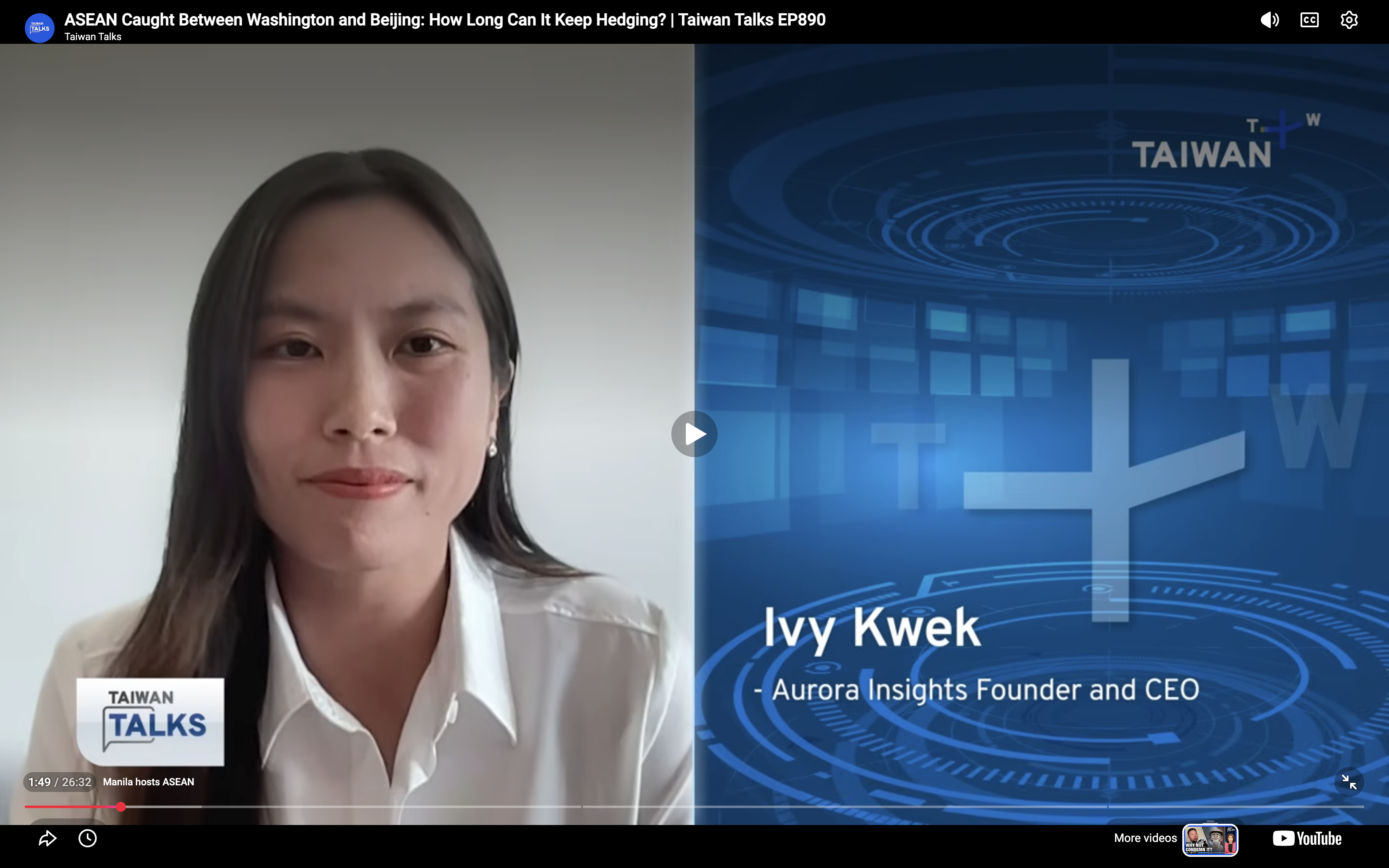
In conjunction with the 59th ASEAN Foreign Ministers’ Meeting held in Manila from 21-24 July 2026, our Founder & CEO Ivy Kwek sat down with Taiwan Talks‘ host Wen-Ti Sung and Chiew Ping Hoo of East Asia International Relations (EAIR) Caucus to discuss the progress of the Code of Conduct on the South China Sea 10 years since the Arbitration Award, how ASEAN is managing the current US-China dynamic, and what’s ahead for US-China relations.
Below is the transcript of her interview:
On South China Sea:
I have been in this industry for 16 years and unfortunately, today we are still talking about very similar challenges and bottlenecks that we talk about when I was a junior analyst. So I think that it is about time that ASEAN find a way, however hard it is to move beyond the rhetorics and actually come to a solution on this issue. If we need any more convincing I think that this week the incident over Second Thomas Shoal should yet again remind us that unresolved issues on South China Sea is literally hurting people in ASEAN. It’s not just about the sovereign, claim but also have very real impact on companies, whether it’s shipping companies or those in the maritime industry as well as the businesses that are relying on those shipping lanes for their goods and products.
Would you mind unpack a little bit more in terms of this kind of geopolitical volatility for the private sector? What kind of impact concretely are they talking about, more insurance premium or some other challenges facing them?
Yeah, that’s right. having a higher insurance premium is definitely one of those [challenges], and also supply chain resilience, the supply chain has been disrupted not just in South China Sea as well as in the Middle East and the Strait of Hormuz. It’s again reminding us how important freedom [of] navigation is and the importance of the maritime domain to the livelihood of the region.
You’ve been working on South China Sea for quite a while now and we know that this code of conduct for behavior in the South China Sea, they started talking about it back in 2002. This is year 24. Do you see year 24 or maybe year 25 to be the charm this time around?
The host this year, the Philippines have set a very ambitious target of concluding it this year. They are pushing it really hard, rightly so because the Philippines has one of the highest stakes being the country with the most frequent clashes with China in the South China Sea, but also because what we see in the straits of Hormuz has once again remind us on the urgency of securing our waters. I think that it’s quite unlikely that it will conclude this year, predominantly because of two sticking points that have been ongoing for a while. One is whether or not the code of conduct should be legally binding. That is some something that most ASEAN states would like it to be but it’s something that China has not committed to. The second thing is this definition of outside power, [it seems that] China [want] to restrict the role of the so-called outside power such as the US or Japan or other non-claimant states [and] their activities in South China Sea.
Ivy, let me ask you, how do you look at how ASEAN is managing uh this US-China competition to win over hearts and minds of ASEAN states?
Under President Trump we can see that the US approach towards the region is much narrower and also more transactional rather than strategic. We have seen that there are certain things that the US care about a lot, for example critical minerals, the US is pursuing critical mineral deals with a few countries including Malaysia and Thailand, and they have also courted the Philippines and Singapore to sign on to its Pax Silica framework. On the other hand, China continues to also court Southeast Asia because Southeast Asia is still very integral to its neighborhood diplomacy. China does it more through the building of institutions, whether is the regional comprehensive economic partnership (RCEP) or the Shanghai Cooperation Organization (SCO) or the latest one being the World AI Corporation Organization (WAICO) that China has announced. So we can see that both superpowers are competing for ASEAN’s alignment so to speak and I think that for ASEAN, again they will pick and choose to see how each of the agenda that is being pursued by either US or China is of interest to them.
How do you see the Iran war is affecting uh how ASEAN or how Southeast Asia may be looking at the US, both in terms of US decision making in foreign policy term but also in how US is doing in terms of war performance.
I will dissect this in two ways. One would be what the Southeast Asian countries feel about what the US is doing in the Middle East. I would say quite bluntly that I think most Southeast Asian countries see the US as being a bully, whether it is towards Iran or towards Venezuela. This needless to say does not bode well for the trust towards the US. Southeast Asian countries have experienced it themselves too, where the US is punishing the Southeast Asian country through tariffs for essentially doing business with China. Second point is that with the US commitment in the Middle East, will the US still be able to uphold its commitment to the region? We’ve seen that the Indo-Pacific strategy has been downplayed under this current administration, they have even changed the name of Indo-Pacific command back to [US] Pacific Command, so we have definitely seen a shift in terms of US foreign policy posture.
On strategic hedging:
If I may add, I think that Southeast Asia has gotten very good at balancing, both their economic interests and also their strategic or political interests. To a lot of outsiders, it seems like it’s indecision but it’s actually not. We would argue that it is actually a very disciplined strategic choice to be able to hedge [this] way and able to make very hard decisions in this very unforgiving geopolitical environment.
Ivy, how do you look at US China relations today in terms of managing this so-called managed strategic competition? Are they building meaningful and effective security guardrails at the moment?
So, if you look back at the summit in May where Trump visited uh Beijing, it was very scant on the details. There were no structural breakthroughs, but it did achieve one thing, which is the perception of “manage stability”. It is to the benefit of both powers, and the perception itself IS the guardrail, that there is the understanding that both sides want a stable or bilateral relationship uh between the biggest superpowers in the world right now.
Ivy, any main indicators you’ll be watching out for in terms of looking at how US-China relations may evolve in the months to come?
Yes. I would definitely be watching very closely on the September Xi’s visit to Washington. Specifically it would be interesting to watch the trade truce that was agreed between the US and China last October and supposed to expire in November, [if] the visit would bring about a concrete result on extending the trade truce. I would also be watching if there both the US and China make any headways in terms of resolving any structural tensions, whether is on issues like AI governance, semiconductor access, rare earths or nuclear arms control, just to name a few. These are the issues that will determine whether the relationship will hold past the photo op.
Leave a Reply