
By Conor Salcetti, Analyst
Indonesia’s attempt to route key commodity exports through a single state channel is not an outlier. It is the latest expression of a regional turn that businesses must now treat as durable structural reality.
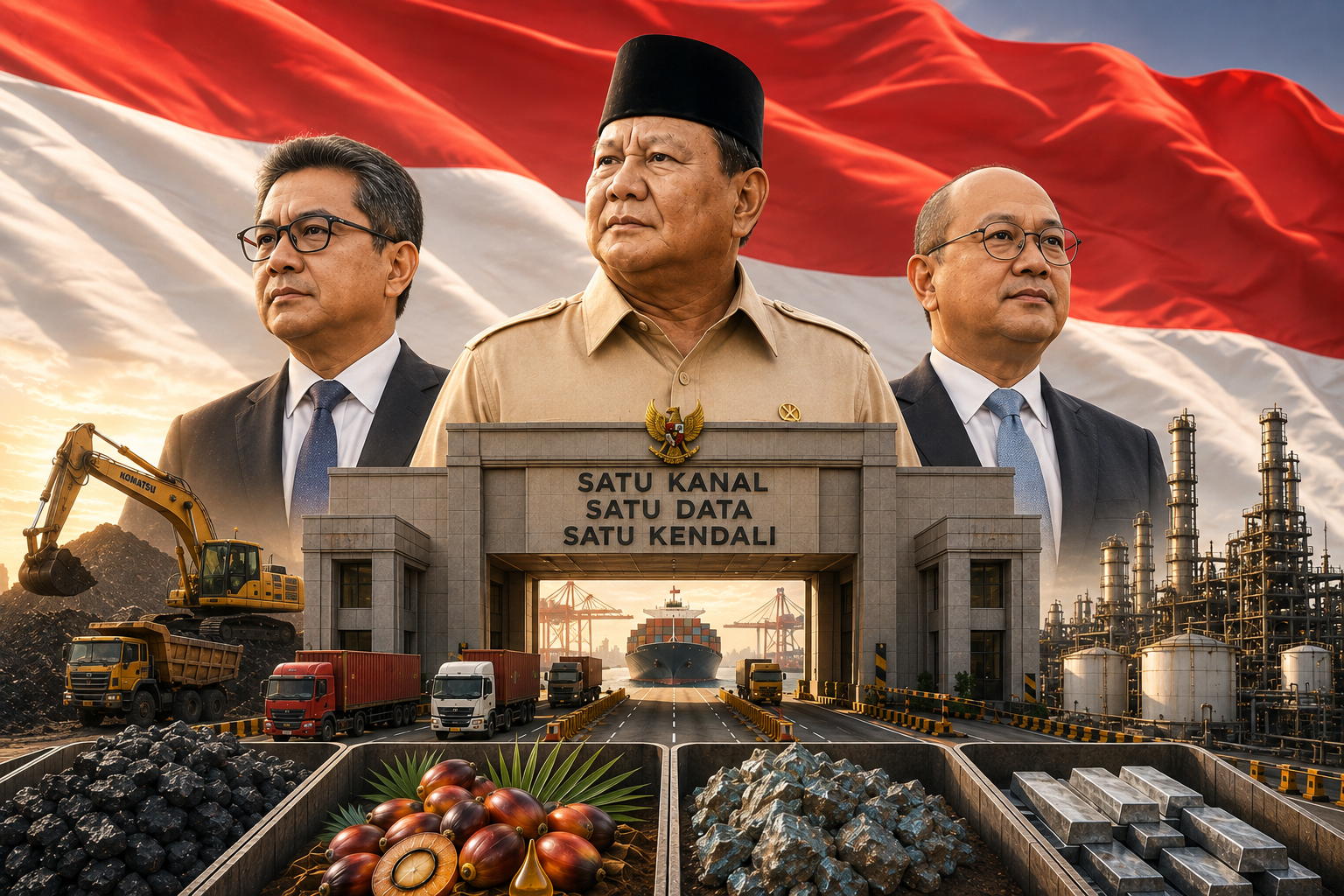
In late May, during a characteristically combative address to parliament, President Prabowo Subianto announced that Indonesia’s future exports of coal, crude palm oil, and ferroalloys would flow through one state-owned channel: PT Danantara Sumberdaya Indonesia (DSI). Later statements from the Indonesian government made clear that by January 2027, roughly $65 billion in annual trade was set to be funneled through a single trading entity that was legally approved just one day before Prabowo’s speech.
That was not the end of the story, however. In the face of a severe market backlash that followed the announcement, officials insisted the state had never intended to earn margin buying and reselling key commodities. Instead, what DSI would offer is an “integrated governance system” processing export data and charging service fees. Then, Prabowo announced in late July that the initial transition phase that started on June 1 would soon give way to full implementation in September 2026, four months earlier than the originally planned January 2027 target.
The DSI intervention should not be seen as an isolated event. Across Southeast Asia, governments are wielding sovereign control over national endowments more aggressively than before, whether it is in Indonesia, Malaysia, Vietnam, or Thailand. The political logic varies by country, but the direction has held for years.
Indonesia: The Trend-Setter
Indonesia offers the most instructive and consequential case, of which DSI forms only part of the picture.
Jakarta’s brute-force industrial policy is a major driving force. Indonesia’s 2020 ban on raw nickel ore exports essentially forced foreign processors to build their smelters inside the country, bringing capital, technology, and jobs with them. The results were dramatic: within just a few years, nickel export value jumped almost tenfold according to Indonesian officials. The lesson throughout the region was simple: restrict raw materials and then capture the value-added downstream processes.
Now, under Prabowo’s leadership, that industrial logic has been folded into something bigger and more aggressive: a systematic push to centralize economic control that has often unsettled investor sentiment. The Danantara sovereign wealth fund, launched in February 2025 with nearly $900 billion in targeted state assets, has become the primary vehicle for this consolidation.
The orientation toward resource nationalism is also apparent in Jakarta’s focus on food security. For example, a series of 2025 presidential regulations require Pupuk Indonesia, the state-controlled holding company that controls virtually all indigenous urea-based fertilizer production, to prioritize domestic agricultural needs over export revenue.
A Regional Pattern: The Cases of Malaysia, Vietnam, and Thailand
Neighboring Malaysia has shown a similar statist turn. In early 2024, Kuala Lumpur imposed a moratorium on unprocessed rare earth exports; in November 2025, the natural resources ministry set it as the first phase of a longer industrial strategy, with the ban slated to continue past 2027 until more domestic processing plants are running. Malaysia already hosts the largest rare earth separation plant outside China, an Australian-run facility on Malaysian soil, and is betting that being the one credible alternative refiner will pull more capital and technology onshore. But that bet is now being renegotiated: a Malaysian deputy minister recently indicated that the government is weighing conditional exemptions tied to investment and technology transfer.
Meanwhile, Vietnam amended its minerals law in December 2025 to ban unprocessed rare earth exports, placing all mining and processing under state-designated companies. Though the country’s lack of commercial-scale refining suggests Hanoi is building legal architecture faster than it is building leverage, the message to foreign investors is clear: rare earths access is increasingly predicated on the inflow of capital and advanced technology.
Thailand’s response was quicker and less strategic. As the Iran conflict pushed energy prices up, demand for palm oil both at home and abroad climbed with it, and Bangkok moved to keep supply inside the Kingdom. From April 7, no one could ship crude palm oil overseas without written government permission, a control set to run for a year. This is defensive resource nationalism in its plainest form, and it is the version most likely to recur as Southeast Asian capitals scramble to shield themselves from shocks they had no part in creating.
The Road Ahead
The motivations behind this trend, namely industrial ambition, revenue capture, protection from supply shocks, are durable regardless of commodity cycles. For companies with ASEAN exposure, understanding why governments are making these moves, and how specific sectors will be affected, will help inform strategic business decisions to mitigate these risks.
- Commodity traders face the most direct disruption, with the Danantara mechanism ratcheting up next month and its fee structure still undisclosed weeks from launch.
- Battery manufacturers dependent on Indonesian nickel will face down a state that has greater power to affect pricing, and should map which suppliers route through DSI and press them on how the undisclosed fee structure will be managed.
- Electronics and defense firms sourcing rare earth magnets outside Chinese channels should closely monitor policy adjustments impacting Malaysia’s midstream development.
- Companies planning to invest, source, process, or partner in Vietnamese rare earths should separate legislative ambition from operational capacity. The legal architecture is in place; the refining capability is not.
- Agribusinesses should expect export-approval regimes to appear with little notice during price spikes, and to be withdrawn or diluted under producer pressure and public backlash.
Firms should therefore treat resource access not as a constant but as a shifting variable and plan accordingly. That means taking stock of inputs that run through a single country’s sovereign control and building alternative sources before a policy change forces the issue. It also means engaging state interlocutors periodically to avoid falling out of alignment with national priorities.
The Indonesian case offers resource nationalism on full display. As the geopolitical landscape becomes more trying, individual countries will continually embrace protectionist policies as the entire region watches and learns. Businesses must adapt accordingly to create a sustainable and profitable environment.
Leave a Reply